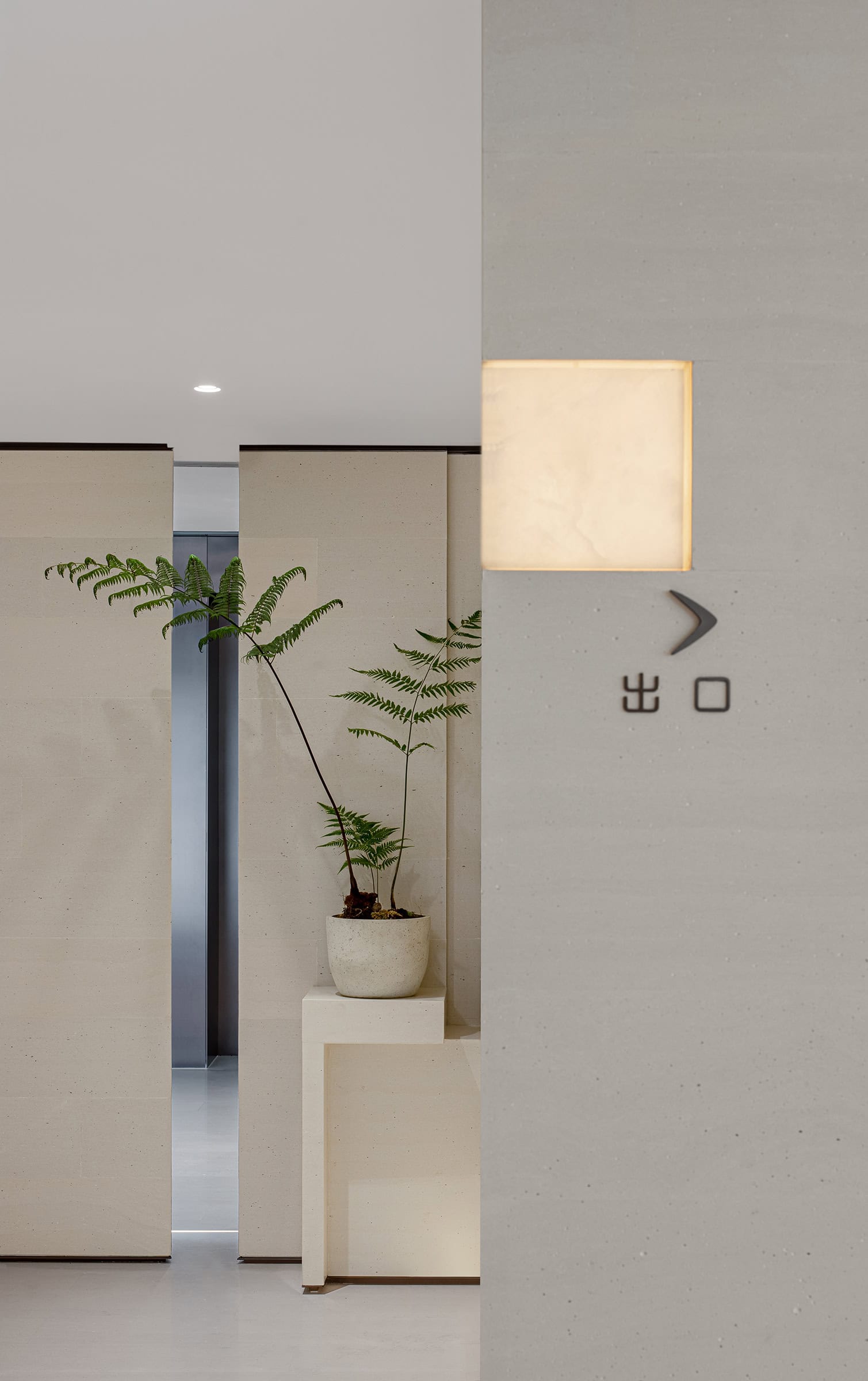
Yuexiu Flourishing Bay Sales Center
Poetic Space Design

Short description
The project is housed in a Sheraton Yuexu Hotel annex building in Nansha, which will serve as a hub for sustainable art experiences.
On the geometric core of the International Financial Island on the shore of Nansha, Poetic Space Design redefines the relationship between art, space, and nature as the overall design unit of hard decoration and soft decoration in this case, upholding the spatial positioning of long-term design.
For the first time, poetic space design seeks to utilize architectural design techniques to echo the space and the shape of the site, with horizontal and vertical lines to explore the full extent of the site structure, which is done in order to make the most use of the original building space.
The large space is broken down and reorganized using volume suspension cutting, and the free and flexible flowing poetry of art space is rebuilt through the dynamic line layout of space demarcation, penetration, and flow. With “empty” as the core, the design of the case considers factors from the dimension of time and space.
The limitations of the space enact the commensurate concessions. The sculpture of a fantastical person with textures of bronze and glass interacts with the top fake skylight. Scarpa’s ground-level architectural features exhibit the texture of organic flow.
The designer improves the “sea” elemants and pays close attention to how space nodes expressed themselves artistically. The scarpa’s architectural details are highlighted by the transparent water drop art installation, the rough Nicke stone on the wall surface, the lemon jade transparent stone flowing in the corner, and the art hanging paintings that are interwoven into three-dimensional woven graphics like the undulating waves on the sea. They hold the connection between the local and the universal, resulting in static or dynamic space emotions, in addition to being the level of space art building.
Due to the project’s initial beam and column structure’s constrained space level, the designer changes the building’s dense horizontal curtain wall into a vertical grid with generous spacing. The space’s axis and region have been determined after numerous efforts, and the tall, open form and the screen with a shifting longitudinal axis and feeling of sequence give the area a rich visual experience.
In addition to the physical object itself, the location also has the confrontation and fusion brought about by the lines and white space, the soft and vertical texture, the intersection of light and heavy, as if the tide brought by the sea, looking between, looking up at the light in the dark, and staring at the deep pale.
The water bar’s floor frame is extremely smooth. The appropriate straight lines are arranged in a generous, firm, straightforward, and clean manner but without any ripple. With the contrast of the bare spaces and the stone and metal materials, the clean lines and fine material technology communicate the poetry of modern aesthetics and minimalist philosophy with every minute point.
The experience of the public space is considered when it is in close proximity to nature, and the space layout can also accommodate the cultural and artistic experiences of the public space. The negotiating area uses a central axis layout, and through a glass curtain wall, the end view and a sofa surround an open viewing core area, forming a complete and free-flowing free line with the sand table, the water bar, and the staircase leading to the third story.
A black landscape stone is imbedded in the white, hard background of the facade of the stairway leading to the third floor. You can see the shifting lines flowing on the stone from the conflict of black and white's straight, linear tension. The surface pattern of the black blocks highlights the space's longitudinal coherence.
The area emphasizes temperament and gives the spiritual realm priority. The hallway is completely covered in a crisp, natural white color. A visual sense of formal order and a somber sense of ceremony are created in the space by the modest nightlight placed in the kicking position. The rest and waiting area's angular geometric components maintain the space's general visual theme. The sophisticated khaki gray leather sofa infuses the room with calmness and leisure, making it ideal for the daily space scene of numerous art shows.
The VIP negotiation space’s furniture are simplified, and the room’s dominant colors—plain black, beautiful brown, and peaceful khaki gray—take their place. The children's area's Lego walls and chairs demonstrate the imaginative world-building that goes into building for young minds.
The three-story public art museum adheres to the tenet that “Empty” is more like a blank sheet of paper than a simple shape of space, making it simple to pique people's desire to express themselves. Although black and white are unmistakably binary opposites, oriental philosophy sees them as interrelated relationships. Black and white are one in the silent white space, and virtual and real things coexist there. Use both horizontal and vertical geometric lines to achieve overall spatial equilibrium.
The interior should complement the architecture and have a dialogue with it in order to give the area a distinctive creative personality. In an effort to explore a spiritual resonance beyond material resonance in the flowing poetry, the designer gives more thought to the space’s long-term sustainability and constructs an art field with temperature.
Entry details